
The Maps We've Relied On No Longer Match the Terrain
For generations, we understood change as a linear progression from one state to another. Leaders defined a destination, developed a plan, and guided people toward it.
Today, the landscape is far more complex.
Organizations, communities, and individuals are navigating multiple, overlapping change processes simultaneously. Different groups occupy different realities. What appears to be progress in one area may feel like uncertainty or loss in another. And new possibilities emerge while familiar landmarks disappear.
The challenge is no longer simply deciding where to go. It is learning how to read the terrain itself.
We develop the deep perceptual intelligence required to interpret the dynamics of complex change, integrate underlying patterns and behavior, and respond with clarity and precision in real time.
Today, the landscape is far more complex.
Organizations, communities, and individuals are navigating multiple, overlapping change processes simultaneously. Different groups occupy different realities. What appears to be progress in one area may feel like uncertainty or loss in another. And new possibilities emerge while familiar landmarks disappear.
The challenge is no longer simply deciding where to go. It is learning how to read the terrain itself.
We develop the deep perceptual intelligence required to interpret the dynamics of complex change, integrate underlying patterns and behavior, and respond with clarity and precision in real time.
Rebecca Reynolds
Three Decades Working with Change in Action
Many of the assumptions that shaped traditional approaches to change no longer fully account for what people are experiencing.
What if change is not simply a process to manage, but something to perceive differently?
What if it unfolds through distinct thresholds—moments when identities, relationships, systems, and possibilities reorganize in fundamental ways?
"Most of our assumptions about how change unfolds are incomplete. After working in transformational change for three decades, I began noticing recurring patterns that conventional approaches weren't explaining."
For more than 30 years, Rebecca Reynolds has supported leaders, organizations, and communities across sectors, disciplines, and cultures who are navigating complex transformation. Over time, she observed consistent patterns in how major change actually unfolds.
Those observations became the foundation for Thresholds of Change™—a practical framework for identifying where people and systems are within a change process and the thresholds that signal movement.
Today, her work supports leaders and teams to navigate complex and evolving environments.
Many of the assumptions that shaped traditional approaches to change no longer fully account for what people are experiencing.
What if change is not simply a process to manage, but something to perceive differently?
What if it unfolds through distinct thresholds—moments when identities, relationships, systems, and possibilities reorganize in fundamental ways?
"Most of our assumptions about how change unfolds are incomplete. After working in transformational change for three decades, I began noticing recurring patterns that conventional approaches weren't explaining."
For more than 30 years, Rebecca Reynolds has supported leaders, organizations, and communities across sectors, disciplines, and cultures who are navigating complex transformation. Over time, she observed consistent patterns in how major change actually unfolds.
Those observations became the foundation for Thresholds of Change™—a practical framework for identifying where people and systems are within a change process and the thresholds that signal movement.
Today, her work supports leaders and teams to navigate complex and evolving environments.
Ways to Engage This Work
Thresholds of Change™ is applied through direct engagement with leaders, organizations, and learners working in conditions of complexity and transformation. Each format strengthens the ability to perceive, interpret, and respond more effectively in conditions of uncertainty and continuous change.
Executive Advisory
Thought partnership and advisory work with senior leaders and executive teams applying Thresholds of Change™ to real-time strategic and organizational challenges.
Learning and Education
Courses and workshops designed to build practical capacity for leading and working within transformational change.
Speaking
Presentations and facilitated conversations that help leaders and organizations understand the dynamics of transformational change and complexity.
Thresholds of Change™ is applied through direct engagement with leaders, organizations, and learners working in conditions of complexity and transformation. Each format strengthens the ability to perceive, interpret, and respond more effectively in conditions of uncertainty and continuous change.
Executive Advisory
Thought partnership and advisory work with senior leaders and executive teams applying Thresholds of Change™ to real-time strategic and organizational challenges.
Learning and Education
Courses and workshops designed to build practical capacity for leading and working within transformational change.
Speaking
Presentations and facilitated conversations that help leaders and organizations understand the dynamics of transformational change and complexity.
|
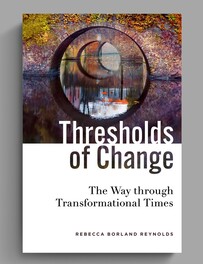
Rebecca is the author of Thresholds of Change, a framework for understanding the dynamics of change. → Learn about the book |